
Spa Filter Housing Types: Identify Yours Before You Order
A cartridge can measure exactly right and the spa still runs cloudy, because the housing decides whether water passes through the media or around it.
Contents
- Identify the housing before the cartridge
- Start from where the cartridge seats
- Read the lid and its seal together
- Find the bypass before blaming the media
- Decide whether the housing can be repaired
- Count what the housing holds
- Match the fittings that feed it
- Treat access as a specification item
- Send the evidence that ends guessing
Identify the housing before the cartridge
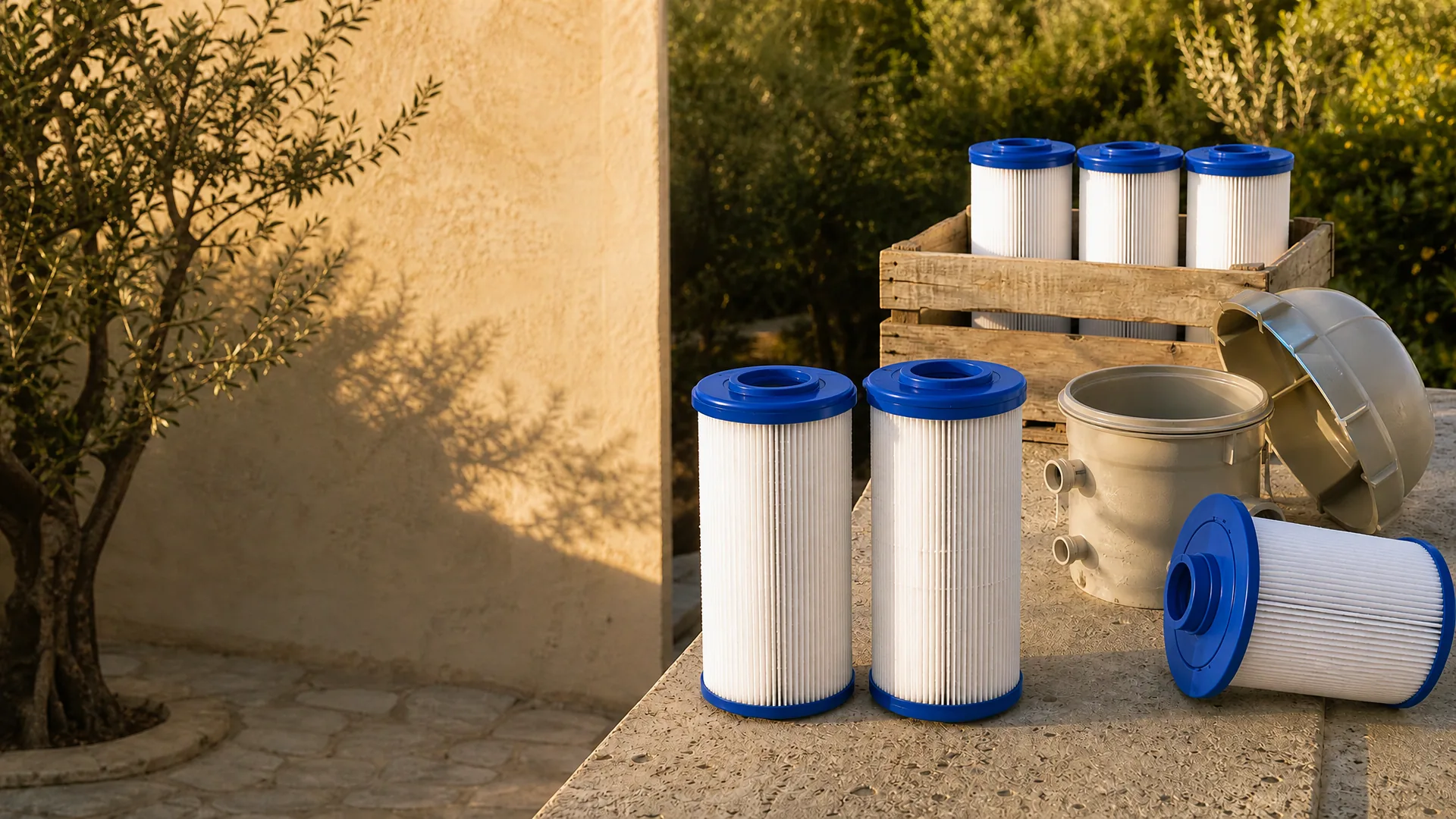
Housing types are sold as one category and bought as three things. The filter cartridge range is built around what seats in a housing, which is the right order: the housing fixes length, diameter, both ends and how the part comes out. Start from a cartridge reference and you choose for a housing nobody described.
Expert tip — Photograph the housing empty. The seat, the lid and the fittings are the specification.
Start from where the cartridge seats
Three arrangements cover most of the spas we are asked about, and each fails differently. Where the cartridge sits inside the skimmer body, the skimmer is the housing: weir, basket, faceplate and shell are one decision, which is why skimmer parts are matched on throat, basket and faceplate. Where it slides over a standpipe, the standpipe centres it and its condition decides whether water still goes through the media. In a closed canister with its own lid, the canister carries the seal and fittings. Seating depth and the lid clamp are confirmed on enquiry.
Read the lid and its seal together
The lid is where a housing leaks without a crack in it. On a skimmer body a faceplate gasket seals the throat to the shell; a warped plate shows against a straight edge. On a canister the lid seal is an O-ring or gasket in a clean groove.
Order the seal with the lid, specified as the joint is built: inside diameter, cord or section, hardness and the material the water allows. A ring bought by nominal size reaches a housing built to another section and weeps.
Find the bypass before blaming the media
Water that travels around the media leaves a cartridge looking clean and the spa cloudy. A cartridge short for the housing never seats. A damaged end cap or deformed thread stops sealing even at the right length. A by-pass valve, locator tab or screen that no longer seats sends flow past the media entirely.
Those features are part of the fit. The replacement and sizing guide covers the cartridge side; the housing side decides whether a correctly sized cartridge can seal.
Decide whether the housing can be repaired
Housing material sets the options. ABS and PVC can be solvent- or heat-welded by a plastics shop, so a crack away from the throat or seal face is sometimes a repair. A crack through a seat, thread or screw pattern is not: nothing sound is left to seal against.
Expert tip — A housing that weeps straight after a cartridge change was more likely disturbed than worn out.
Count what the housing holds
Most housings take one cartridge; some take a pair, matched so both load at the same rate. The count changes the order and the stock policy: one in service, one clean and dry, replenished against one reference.
Match the fittings that feed it
Unions and their seals belong to the joint at the housing inlet. A hardened run decides whether the housing can move far enough to seat a cartridge. A drain plug left off the order is a second shipment for a part worth less than its carriage. Thread standard follows the destination market: seal and union fields and hose specification are read with the housing.
Treat access as a specification item
A housing that cannot be opened will be forced. Clearance above the lid, room to turn a clamp and a hose route clear of the lid are site conditions, not part numbers — on a spa set into a deck the deck decides them, which is why service access is designed in first.
Send the evidence that ends guessing
| Attribute | Why It Matters | What to Look For |
|---|---|---|
| Seating arrangement | Decides whether the housing or the cartridge is the real order | Skimmer body, standpipe or closed canister |
| Lid and seal | The commonest leak on a housing with no crack | O-ring or gasket, groove condition, warped plate |
| Bypass features | Let water skip the media while the cartridge looks clean | By-pass valve, locator tab, screen |
| Housing material | Sets repair against replacement | ABS or PVC, crack near a seat or thread |
| Fittings and market | The joint and thread follow the destination | Union, seal section, drain plug, thread standard |
Every figure above is confirmed on enquiry.
Frequently asked questions
How do I tell which filter housing my spa has?
By where the cartridge seats: inside the skimmer body, over a standpipe, or in a canister with its own lid. The seal and fittings follow from that, so photograph it empty.
Can I order a cartridge from the old one without describing the housing?
You can order a candidate, not a confirmed part. The housing fixes seating depth, lid clearance and bypass, which decide whether a sized cartridge seals.
Is a leaking housing always a replacement?
No. ABS and PVC can be welded where the crack sits away from a seat, thread or screw pattern. Through those faces, nothing is left to seal against.
Do I need the whole housing if only the lid seal failed?
Usually not. The seal is ordered against the joint; the lid is reused if its groove is sound. Send both together.
Next step
Photograph the housing empty, the lid and its seal, the inlet fittings and the clearance above, then send them through the contact page. We will confirm the housing type and what travels with the cartridge.
—
Have a product or sourcing question?
Tell us about your requirements and the decision you are working on.
Discuss your requirements