
Service parts · 02
Plumbing Parts and Seals
The least glamorous category and the one that stops a service call. O-rings, unions, split nuts and adapters, grouped so a repair can be quoted as one kit instead of eight lookups.

What the parts are and where they sit.
Grouped by part type: each group shares a sealing face or a thread.

O-rings and seals
EPDM, Viton and silicone rings for pump unions, heater flanges, jet bodies and drain fittings; cord diameter and inside diameter quoted against the part being sealed.
Gaskets and flange seals
Heater gaskets, jet face gaskets and pump housing gaskets, supplied flat or moulded.
Pump unions and split nuts
Union nuts, tailpieces and split nuts in the trade thread sizes, with the O-ring that belongs to them.
Adapters, bushings and couplings
Reducer and enlarger adapters, bushings and straight couplings between pipe sizes and thread types.
Tees, elbows and manifolds
Plumbing tees, elbows and air manifolds for jet runs and blower lines. Manifolds take a 2 in main with 3/4 in barb branches, solvent weld.


Check valves and clamps
Inline check valves for blower and ozone lines; stainless and plastic clamps for hose joints. True-union ball valves are supplied single or double union, in the 150 PSI PVC class shown in the table.
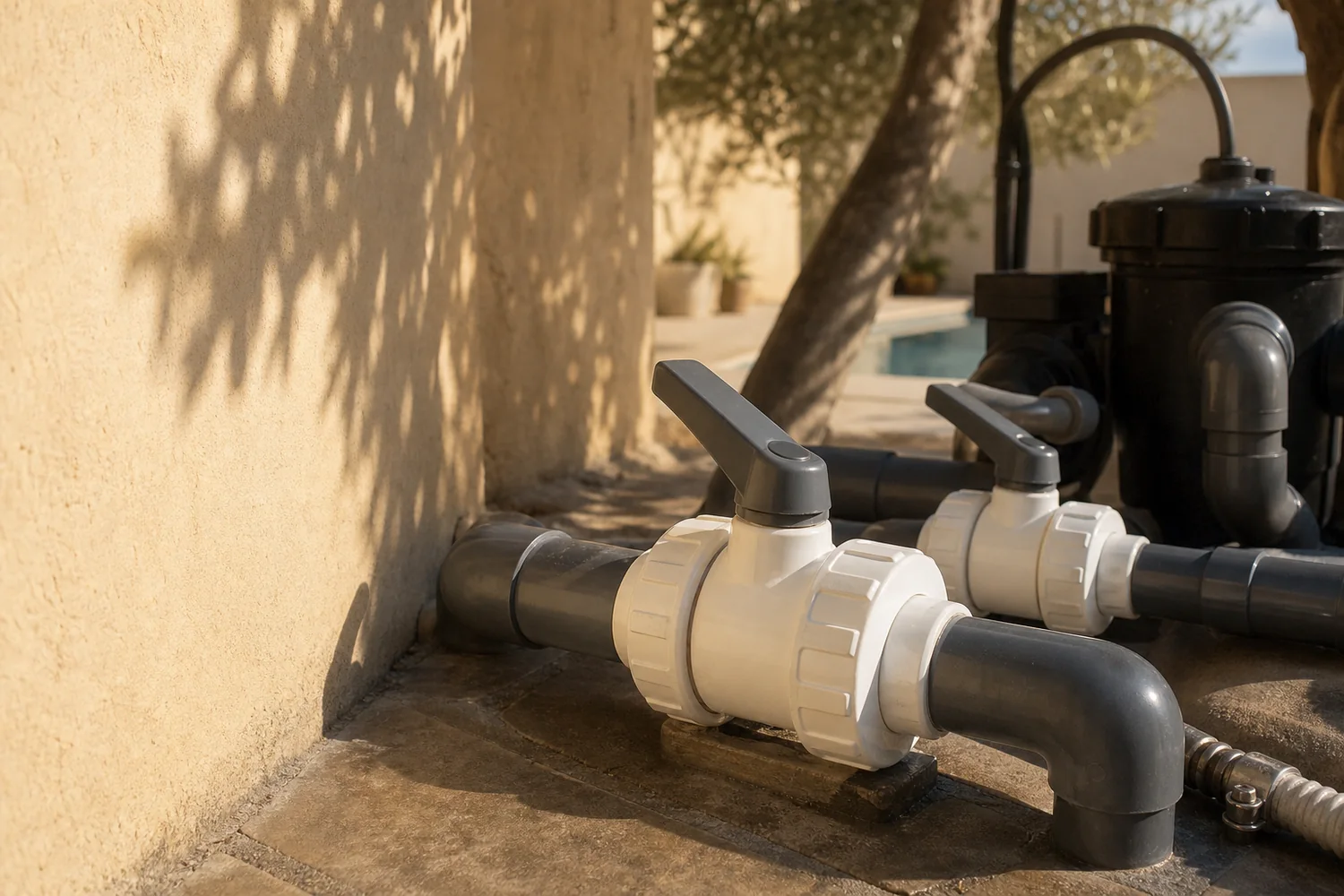


Hose and tubing
Reinforced PVC hose and flexible tubing, cut to length or supplied in coils.
Reference data
Material, bore and face as one set.
Seals are bought by dimension, not by name. The two tables below are what a counter needs to hand over the right ring the first time.
| Field | Typical options and what we confirm |
|---|---|
| Seal materials | Confirmed for the selected model and water-treatment conditions. |
| Fittings and hardware materials | Confirmed per product. |
| Inside diameter | The bore the ring seats into |
| Cord or cross-section | The squeeze that makes the seal |
| Hardness | Seating force and resistance to deformation (Shore A 70 typical; confirmed per enquiry) |
| Thread standard | Whether the fitting will engage (NPT or BSP; confirmed per enquiry) |
| Pipe size | Typical: 1/2 in, 3/4 in, 1 in, 1-1/2 in and 2 in nominal. The size the fitting actually joins is confirmed per enquiry. |
| Pressure and temperature | Typical: 150 PSI working pressure on PVC true-union fittings. Temperature confirmed per enquiry. |
| Contact media | Water, ozone, chlorine or salt, which rules out some materials |
| Reference system | Why it helps |
|---|---|
| Fitting reference | The moulded number on the part |
| Spa brand and model | Narrows the plumbing family used in that cabinet |
| Pipe and thread measurement | The fastest route when nothing is marked |
| Old seal | Confirms the section and the seating face |
| Repair context | Which joint is leaking and what was disturbed |
O-ring and fitting dimensions are quoted per enquiry: the same nominal size is built to different sections by different plumbing systems. Brand names are used for cross-reference only.
What to measure at the joint.
Three photographs and one measurement close most seal enquiries.
- Photo of the fitting or the leaking joint in place
- Photo of the old seal flat, with a rule across the diameter
- Thread photographed across the crests, with a rule
- Pipe size and thread type if known
- What the water carries: chlorine, salt, ozone or bromine
- Whether the order is a single repair or a stock kit
Why kits, not singles.
A service engineer who replaces a pump union usually needs the O-ring, the split nut and the tailpiece in the same box. We quote the set, and the set is what ships.
Repair kits
Grouped by job: pump union kit, heater flange kit, jet body kit.
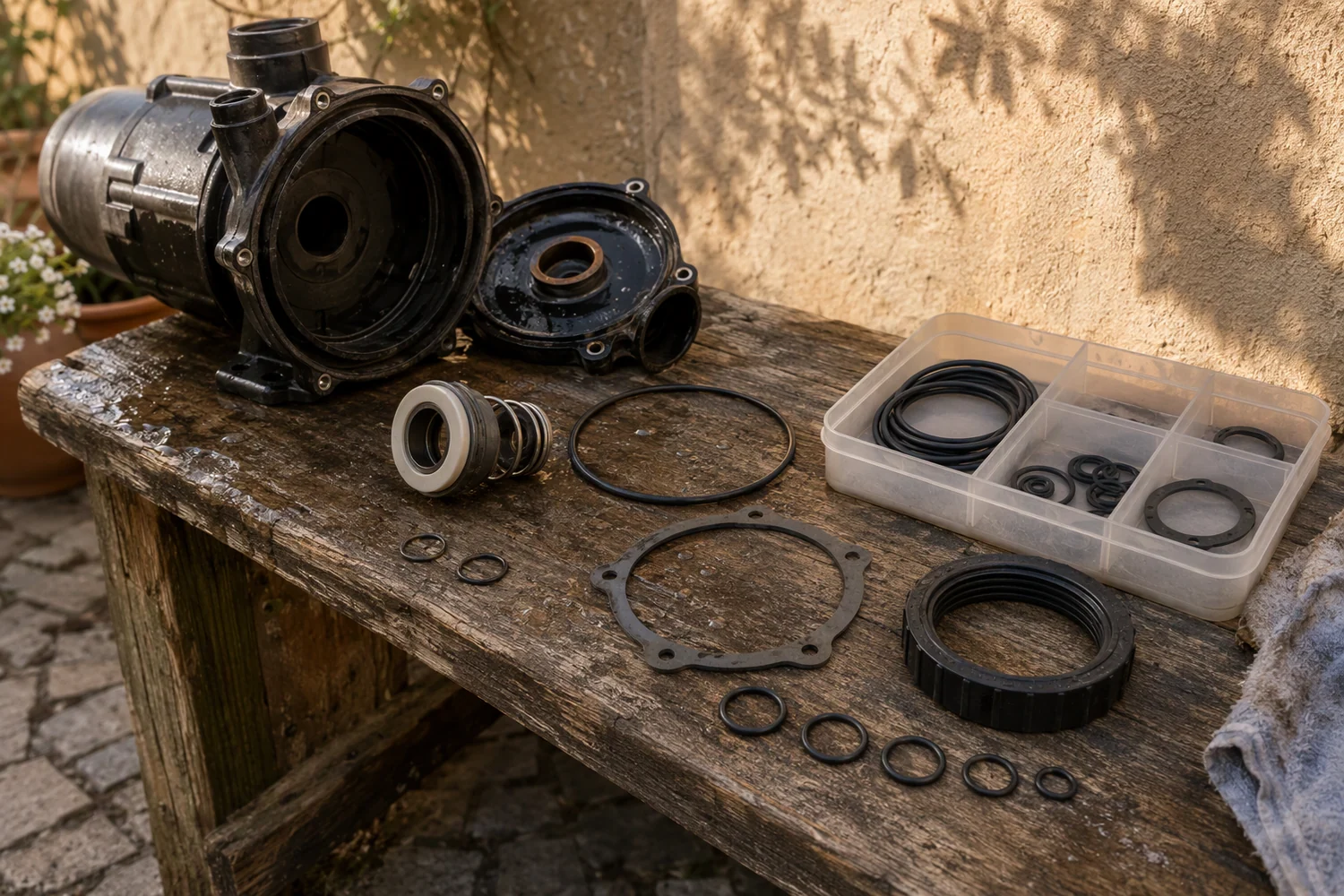
Stock kits for service companies
A defined assortment of the fastest-moving rings and nuts, replenished rather than re-specified.
Single parts
Available, with the same checking. Carriage, not minimum order, is the trade-off.
Related reading: how a seal is chosen by the joint.
Questions about plumbing parts and seals.
Can you identify an O-ring from a photo?
Usually — with a rule across the diameter and the section. Material still depends on what the water carries.
Is EPDM always the right choice?
No. EPDM suits hot chlorine and bromine water; ozone and some oils push the choice to Viton or PTFE.
Do you supply the union nut and the O-ring together?
Yes, and that is the usual way a pump union repair is bought.
Are thread sizes NPT or BSP?
Both are quoted; the destination market and the existing plumbing decide which.
Can you supply a stock kit for a service company?
Yes. The assortment is agreed once and replenished against it.
Do these parts carry a certification?
Seals and fittings are not electrical; where a market asks for drinking-water-contact or material declarations, the paperwork is arranged per order.
Fittings that pair with the seal.
What usually travels with a plumbing repair.


Send the joint detail for a checked reply.
One enquiry covers the seal or fitting, the assembly it joins and the market it ships to. Replies come from the person who checks the specification, not an autoresponder.