
Spa Skimmer Parts: Matching Weir, Basket and Faceplate
The skimmer is the lowest-cost assembly in the cabinet, and in our experience the one service companies are called back to most often. It is normally four parts doing four different jobs, and the part named in the complaint is rarely the part that failed. The skimmer and weir range is laid out accordingly.
The complaint names a symptom, not a part
Four complaints cover almost every call: the water line drops overnight; debris circles and never enters the throat; the pump loses prime and recovers after a restart; water appears inside the cabinet.
Each points at a different part, and only one is a plumbing failure. Working out which one separates a parts order from a second visit.
A weir that sticks open looks like a filtration fault
The weir is a floating or hinged gate that keeps a film of water spilling over the top. It is the only part of the skimmer that moves, so it is the only part that wears at a pivot.
A stuck or damaged weir can reduce surface skimming. Stuck shut, the surface draw stops and the basket fills with what should have floated past it. Both are reported as filtration faults, and both are a gate and a pair of pins — supplied together, because a worn pin is why the old gate stuck.
Basket fit is two dimensions and one clearance
A basket seats on its top diameter and its depth, neither of which can be judged from the maker’s name: handles, lips and rim profiles differ between mouldings even where the throat matches.
Depth causes returns: a basket that is too deep stands proud of the housing and stops the lid closing flat, turning a finished repair into a callback.
Mesh follows the debris the spa actually sees: fine mesh blocks under leaf fall and pulls the pump down, coarse mesh passes grit to the filter cartridge.
Throat width cannot be inferred from the model
The throat is the opening the gate sits in, and it decides whether any weir will work.
Nominal sizes are not interchangeable: the same nominal opening is built to different depths and faceplate fixing centres depending on who moulded the housing, so a part ordered against a nominal size is a guess that comes back.
Measuring takes one photograph — a rule laid across the opening, in the same frame. Measuring from outside does not answer it, because wall thickness and flange sit between the outside face and the throat.
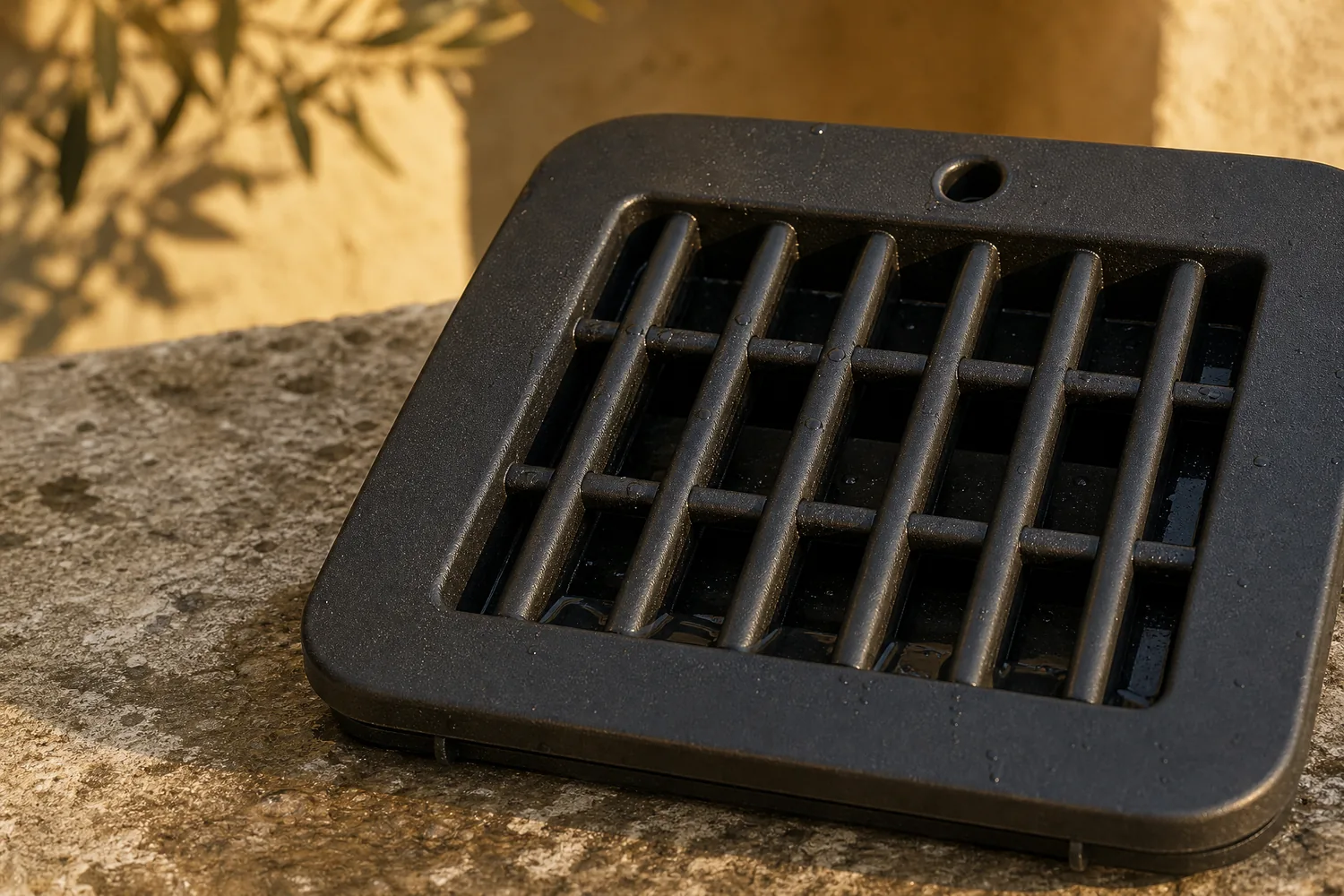
A faceplate leak is usually the gasket
Water at the faceplate is reported as a failed plate far more often than it is one. The gasket is the wear item: compressed against the shell, exposed to the same water chemistry as everything else, and hardening with age.
A plate that has genuinely failed shows it against a straight edge. The gasket travels with the plate deliberately, because a plate refitted onto an old gasket leaks again. Where only the gasket is wanted, say so — it can be quoted alone.
The housing decides whether you repair or replace
A cracked body changes the shape of the order. Everything above is a part; a housing is a repair-or-replace decision, and the material decides which.
Repairability depends on the housing material, crack location and manufacturer guidance. Confirm whether a replacement housing or approved repair is appropriate. A crack through the throat cannot: the gate will never seat squarely again.
Either way, quote the replacement alongside, with its throat width and fixing centres, so the customer chooses between two real figures rather than between a repair and an idea. Check the shell opening too — a replacement has to match the hole already there. The parts that are bought together arrive as one order: the gate with its pins, the basket with the gate when both are worn, the gasket with the faceplate.
When a float valve holds the water line
Some skimmers hold the water line with a float valve and equaliser rather than the spa’s own level control; there, a falling line is neither a leak nor a weir.
The reading that decides it is the normal water line, recorded before anything is dismantled. Without it, a valve fault and a real leak look identical.
An enquiry that comes back right the first time
Six items close a skimmer enquiry: the skimmer photographed in place with the lid open; the throat measured with the rule in frame; the old basket flat on a bench with a rule; the faceplate screw centres, if the plate is coming off; whether the housing is cracked or only the parts are worn; and the normal water line, where a float valve is involved.
Brand, model, year and any moulded number narrow the family and are worth including, but none replaces the two measurements. The plumbing seals and water pumps downstream are quoted on the same enquiry where they are part of the job; the wider list sits on spa components.
Frequently asked questions
How do I tell a skimmer fault from a pump fault?
If the water level falls or the pump loses prime, inspect the water level, suction path, seals and plumbing separately before attributing the symptom to the weir.
Does a replacement basket include the weir?
No. Basket and gate are separate parts, though they are often quoted together as a set when both are worn.
Can a skimmer housing be replaced without cutting the shell?
Only where the existing opening matches the replacement throat and fixing centres, which is why both are measured first.
Which skimmer parts should a service company keep in stock?
Gates with pins and the basket sizes used by the cabinets actually serviced; faceplate gaskets follow the same logic.
Next step
Send the photograph with the lid open, the throat measured with the rule in frame and the old basket flat on a bench through contact, and the reply will name the part, the pairing and the market documents required.
Have a product or sourcing question?
Tell us about your requirements and the decision you are working on.
Discuss your requirements