
Spa Water Treatment Parts: Choosing Between Lamp, Cell and Generator
Water treatment is bought as equipment and replaced as a consumable. That mismatch explains most frustration in the category: the customer believes they own a sanitising system, while what wears out is a lamp, a cell or a chip that was always going to be replaced. Nothing has failed when a consumable reaches the end of its life; treating that as a breakdown buys a unit where a part would have done.
The real question is therefore not which system is best, but which part is in the housing now, what it is matched against, and what else in the assembly is near the end of its life.
Three routes, three different failure points
Ozone, UV and salt are not variations of one product. They fail in different places, and the enquiry has to say which one it is before anything can be matched.
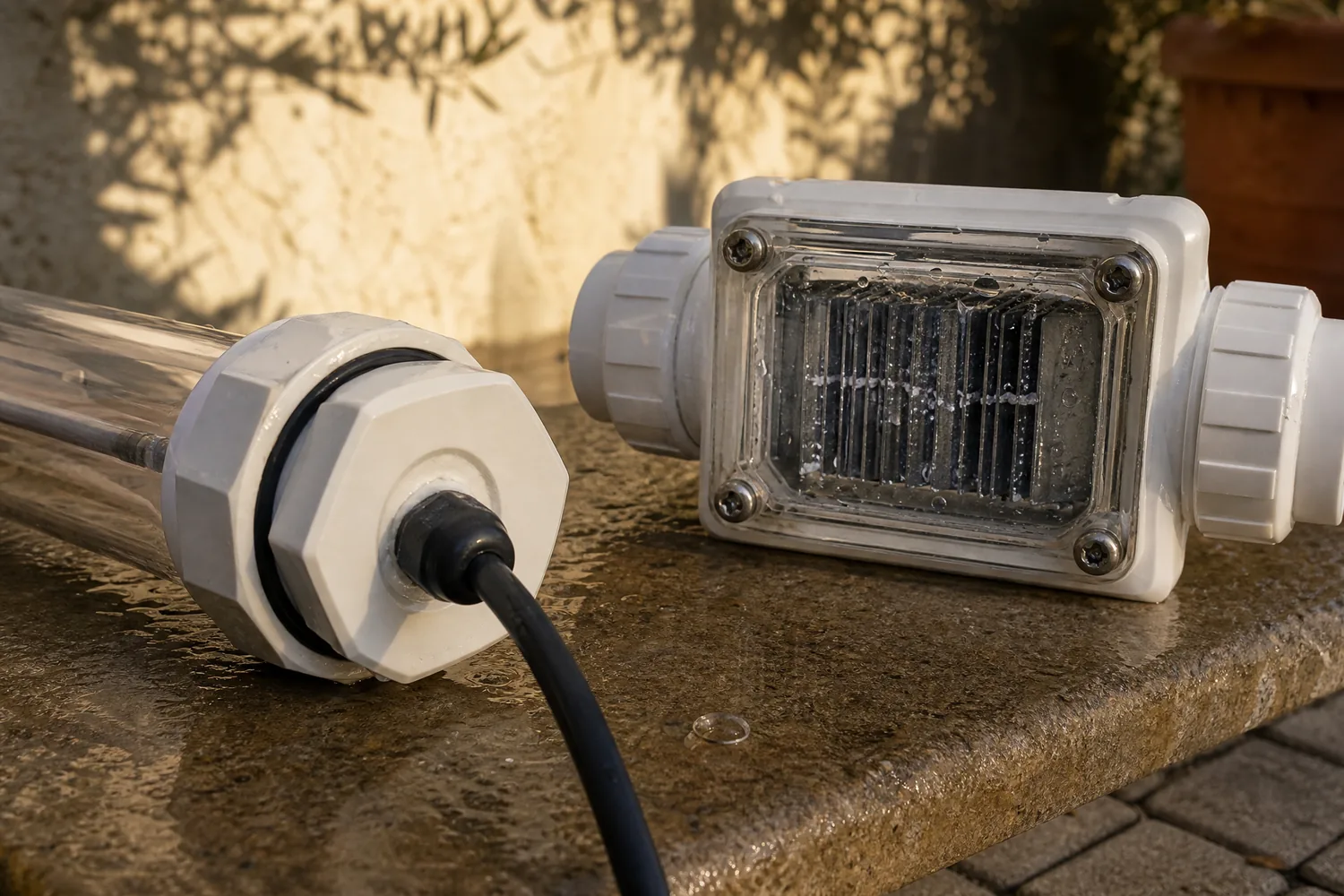
An ozone system fails at its generator chip or at the valve that protects it. A UV system fails at the lamp, often at the ballast driving it. A salt system fails at the electrode cell, whose length is set by the housing it was built into. The water treatment parts range is organised by those columns, consumables first.
Ozone: the valve gives out before the generator
An ozone generator is usually condemned when a smell stops, or water appears where it should not.
Both have a cheaper explanation. Inspect the check valve and generator separately. Chip and valve are replaceable; a cracked corona cell is not, which is the one case where the module itself is the answer.
UV: the lamp and the ballast are one decision
A UV lamp is matched on length, wattage and base, all three printed rather than inferred. Length and base decide whether it enters the housing; wattage decides whether the ballast drives it.
The lamp can be replaced alone where the ballast is sound. Often the two go together, because a failing ballast shortens every lamp it drives — a customer replacing lamps more often than expected is describing a ballast problem, not a lamp one.
The quartz sleeve is a seal as much as a part
Between lamp and water sits a quartz sleeve, and around the sleeve sits a ring. The sleeve has its own dimensions; the ring keeps the water on the correct side of it.
A lamp replaced into a fouled or scored sleeve gives the output of an older lamp, and a sleeve refitted with a hardened ring gives a leak. Both are avoided by buying sleeve and seal with the lamp, the way a plumbing seal is quoted with its joint.
Salt: the housing decides the cell length
Salt cells are not interchangeable across housings. Cell type and length are matched to the housing, which decides which length is offered.
That is why a cell can often be matched without a model number: the length of the old cell, the thread at each end and a photograph of the open housing identify the family. Unions and seals belong to the same order.
Size the proposed system against water volume, flow, operating conditions and the manufacturer’s specifications.
Ozone output and cell capacity are sized against the water the system treats. The spa’s volume in litres or gallons is the one input a customer can supply without tools, and the one most often missing from an enquiry.
It matters most when the water body is not a standard hot tub. A swim spa holds a different volume from the shell it resembles, and a part sized for the smaller body runs outside its duty from day one. Printed output is quoted as declared, not restated as a promise.
Read the label before the unit comes out
Most of what decides a replacement is unreadable once the unit is on a bench. Six readings cover it: the label photographed legibly; the old lamp or cell measured against a rule; voltage and frequency at the installation; the water volume; whether the housing is replaced too; and the destination market, since electrical approval follows it.
The last one is not paperwork: it changes what can ship, and discovering it late delays the order.
Where a supplier should stop
Lamps, sleeves, ballasts, cells, generator modules and their fittings are service parts and are supplied as such. A competitor’s control board is not copied, and a complete unit defined by locked firmware is not reverse-engineered: a copy is not a part a service company can support.
Ordering for a season, not for one repair
A service company buying treatment parts one failure at a time pays carriage on every call and keeps no cover.
The pattern that works is the one used for filter cartridges and skimmers and weirs: agree an assortment once — lamp lengths, cell lengths and generator consumables for the cabinets actually serviced — and replenish against it. Worth checking on the same visit: the heater flange, since the water was drained and the heating element gasket disturbed. The wider list sits on spa components.
Frequently asked questions
How often does a UV lamp need replacing?
The maker declares a rated life in hours. Many domestic spas change the lamp at that interval, so quote the rated hours for the lamp actually fitted rather than a general rule.
Can a UV lamp be replaced without the ballast?
Yes, if the ballast is sound. They often go together, since a failing ballast shortens lamp life.
Are ozone generators repairable?
The chip and the check valve are replaceable; a cracked corona cell is not.
Can a salt cell be matched without a model number?
Usually, with the cell length, the thread at each end and a photo of the housing.
Next step
Send the label, the old lamp or cell measured against a rule and a photo of the open housing through contact, and the reply will name the consumable, what it pairs with, and the documents the destination market requires.
If the same visit disturbs the heater flange, the order for the element and its gasket is set out on that page.
Where the housing is split, the ring that keeps the water on the correct side of the sleeve is quoted with the seal that closes the housing.
Have a product or sourcing question?
Tell us about your requirements and the decision you are working on.
Discuss your requirements