
Wicker Hot Tub Surround: What to Specify Before You Order
A surround is bought for how it looks and accepted or rejected on how it fits. Buyers usually arrive with a picture of a woven finish and leave the fit questions until the drawing stage, which is where the cost and the rework sit. The order below keeps both under control.
Start with the shell, not the weave
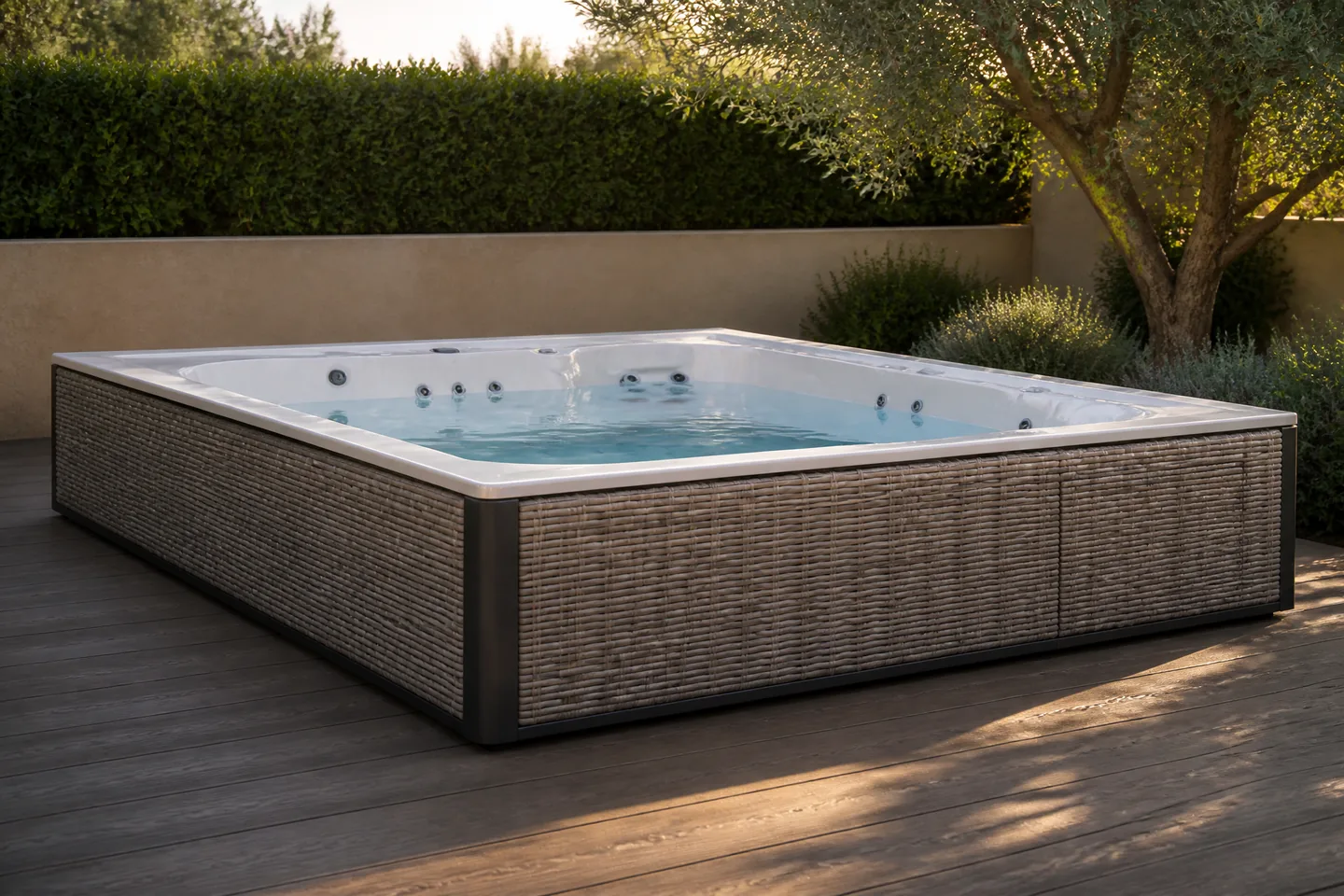
The surround does not carry the water. The acrylic shell keeps its own support, and the wicker is carried on a separate outer frame, so the finish stays level and the tub stays serviceable. That sequence decides everything that follows: the shell dimensions fix the panel layout, the panel layout fixes where the service openings can fall, and only then is the weave a choice rather than a constraint.
Starting from the weave means asking a supplier to fit a look onto an unknown footprint.
What a wicker surround is actually for
Three jobs. It finishes a tub that would otherwise sit as an exposed acrylic shell beside a garden. It hides the plumbing, wiring and service points behind removable panels rather than leaving them on show. And it protects the shell from weather and casual knocks.
Everything else — weave pattern, frame colour, cushions — sits on top of those three jobs.
Panel layout is the price decision
A surround is a modular enclosure, so panel count, corner returns and any recess for steps or a walkway all translate into frame length.
The rail on this range is a standard plan size of 3000 × 2000 mm, with custom sizes and colours made to the tub’s exact footprint. Overall height is set to the finished level and confirmed per enquiry, because it depends on how far the shell stands above the ground.
Fix the plan size and the corner conditions first, then let the panel split follow; changing the split after frames are cut is a rebuild, not an adjustment.
Service access has to be designed in
A surround that has to be cut on site has already failed a test. The panels on this product carry an engraved stainless steel nameplate, a hollow metal wire port at one end for the power feed, and a matching drain port at the opposite end — all formed into the panel rather than cut afterwards.
Ask three things of any proposal: where the power enters, where the drain exits, and how a technician reaches the pump and heater without dismantling the finish. If the answer is “the installer will cut an opening”, that opening lands wherever the equipment happens to be, and the cut edge becomes the one part nobody has specified.
The frame is the durability question
Wicker is the visible layer; the frame is what decides whether the surround is still square in a few seasons. On this range the panels sit on a powder-coated stainless steel square-tube frame, with corners joined by welding and fixed with self-tapping screws, and the top closed by a flat horizontal ledge so the wicker edge runs level all round.
Two questions are worth asking early: which stainless grade, and how the corners are joined. A surround beside a chlorinated tub or near a coast keeps the frame in salt air and humidity, and that is what a photograph never shows.
Colour, cushion and finish belong in one conversation
Frame colour and wicker colour are usually quoted as one pair, and the pair should be chosen against the deck, the wall or the planting the tub sits in — not from a swatch on its own. This range is offered in a dark-grey frame with light-grey wicker as standard, with custom colourways available, and matching colour seat cushions are made for the same surround system.
Decide them together: a cushion ordered later, against a different batch, is how a finished installation ends up looking assembled rather than designed.
What to send with a wicker surround enquiry
- The shell footprint, with an outline drawing or a dimensioned photograph taken square-on.
- How far the shell stands above the finished ground, and what the finished surface will be.
- Photographs of the equipment positions: pump, heater, control pack, drain.
- The colourway you are working to, and whether cushions are part of the order.
- Destination market, indicative quantity and whether your branding is involved.
Frequently asked questions
Does a wicker surround fit any hot tub or swim spa?
It is made to the shell footprint rather than sold as a universal size. Send the plan dimensions and the corner conditions, and the panel layout is set from those; the standard plan size on this range is 3000 × 2000 mm, with custom sizes available.
Can the surround be supplied in a custom size and colour?
Yes. Sizes and colours are made to the tub’s footprint and to the colourway you are working to, including custom options beyond the standard dark-grey frame and light-grey wicker.
Where do the power cable and the drain come out?
Both are formed into the panels rather than cut on site. A hollow metal wire port sits at one end for the power feed, a matching drain port at the opposite end, and the brand nameplate is engraved into the panel.
What is the minimum order?
One piece. Price and lead time depend on the quantity and the product, so both are quoted against your actual requirement.
Next step
Review the frame, panel and access details on the rattan surround page, and compare it with skirt panels if the tub only needs a cabinet finish rather than a full enclosure. Where the cover and its handling also need to be settled, the spa covers page covers the outline and fold questions.
Send the shell footprint, the equipment photographs and the colourway through contact, and the panel layout comes back against your drawing rather than a catalogue size. The rest of the range sits on the spa components overview.
Measuring the cover before you order follows the same logic: see how to measure a spa cover before replacing it. If the cover is already sound and only the lifting arrangement is in question, start with cover lifters.
Have a product or sourcing question?
Tell us about your requirements and the decision you are working on.
Discuss your requirements