
Spa LED Light Replacement: Match the Fitting, Then the Supply
A spa light is a lamp, a lens, a gasket and a length of cable. Three of the four are consumables, and the fourth is usually why the other three get replaced. Most mistakes in the category come from starting at the lamp, the one part that can move. The LED spa lighting range is organised by the parts that fail; the order they are chosen in runs the other way.
The fitting is the only part that cannot move
The fitting is moulded into the shell, so a service call cannot change it. Everything else is decided around it.
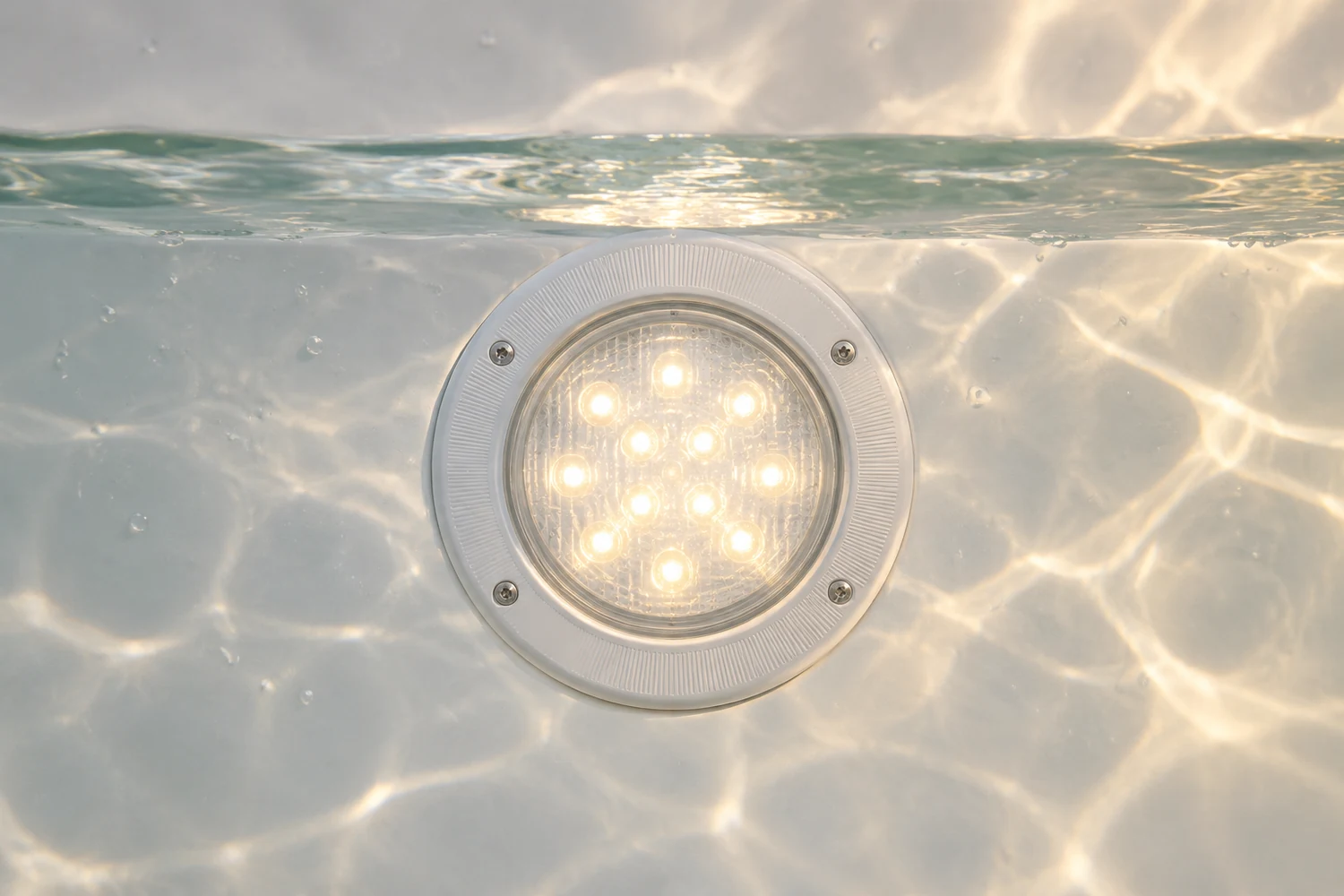
The spas we see most often have a recessed housing moulded into the shell; confirm it on the unit before ordering. Confirm the fitting and electrical interface on the installed model. Measure the fitting, not the recess.
Two readings matter; only one usually gets taken. The diameter across the opening decides which lamps will enter at all. Seat depth decides whether a lamp sits square against the seal or stands proud of it, and it cannot be read with the lamp in place. Both are taken with the water down.
Fitting the opening is not the same as sealing it
A lamp that matches the diameter will drop in. Whether the assembly holds water is decided by the lens, the ring behind it, and the retaining ring that keeps the lamp square.
A lamp chosen on diameter alone fits and leaks. The return arrives with water behind the lens, which reads as a failed lamp rather than a failed seal. Lens and gasket are supplied with the lamp for that reason, not as a separate line.
Fog is a gasket symptom
A fogged lens is reported as a lamp on its way out. Moisture inside a light assembly calls for inspection of the lens, housing, seals and cable entry. Confirm the fitting and electrical interface on the installed model. Request the documentation required for the destination market and verify it for the proposed product. Both are replaceable and cost less than the lamp they are accused of.
Separating them changes what to order: water inside the lens with the lamp still lit is a seal job; dry and dark is a lamp job; dry and dim is the supply.
White or RGB is a control decision
Colour is not chosen at the lamp. A white lamp needs a low-voltage supply and nothing else. An RGB lamp needs a control that drives the colours, and that control is a separate part of the circuit.
This is the commonest mismatch in the category: a customer asks for colour and receives a lamp that lights white. Where colour is wanted, the control belongs in the first message.
The connector identifies the family faster than the model does
Connectors differ between families even where the fitting and the supply appear to match, and the plug at the end of the harness separates them faster than paperwork.
A close photograph of that plug answers more than a model number: models change with the cabinet, connectors persist with the moulding. The harness and any extension are ordered on the same reading, since both ends have to mate.
The transformer is sized by the circuit, not the lamp
A supply is sized to the load on it, and the load is every lamp on the circuit added together. One higher-rated lamp can push a marginal supply over its limit, which is why the transformer label and a lamp count belong in the same enquiry.
An undersized supply rarely fails outright. It dims, flickers or runs hot, and shortens the life of everything downstream. Headroom is the difference between replacing a lamp once and replacing it every season.
Cable run, gland and the way into the cabinet
Length runs from the fitting to the control box, following the route the old cable takes: around the shell, through the cabinet, past whatever framing is in the way. Surplus is coiled and fixed rather than left hanging, because a cable that moves abrades at the gland.
The gland is the part that gets reused and should not be. It keeps water out where the harness enters the cabinet, and a hardened gland leaks. It travels with the harness where supplied as a set.
Low voltage, and approval follows the market
The range is low-voltage lamps and their supply; mains-voltage lighting is not part of it. That is a design boundary rather than a stock position, and it is what lets a lamp be serviced with the water down.
Request the documentation required for the destination market and verify it for the proposed product. Discovering it after the parts are picked delays the order and sometimes changes the part.
Photographs that close a lighting enquiry
Five images settle most lighting enquiries: the lamp in the fitting with a rule across the opening; the connector close up; the transformer label; whether the colour is white or RGB and what switches it; and whether water has entered the lens.
Brand, model and year narrow the family, as do the cable length and whether the spa is drained for the job. The seals that keep the fitting watertight are quoted on the same enquiry where the gland or ring is part of the job; the wider list sits on spa components, indexed from all products.
Frequently asked questions
Can a spa light be changed with the water still in?
Only where the fitting allows it. Most fittings are sealed to the shell and are serviced with the water down.
Will an RGB lamp work on a white circuit?
No. RGB needs a control that drives the colours; a white circuit supplies power and nothing more.
How can I tell whether the supply is undersized?
Dimming, flicker or a supply that runs hot, most visibly with every lamp on the circuit switched on together.
Do I need the lamp brand to order a replacement?
No. The fitting measurement and a connector photo identify the family; output figures are quoted as declared by the maker.
Next step
Where the supply is the question rather than the lamp, the transformer that feeds the lamps is covered on the box side. Send the photograph across the fitting, the connector close up and the transformer label through contact, and the reply will name the lamp, the seal and the supply it needs, with the approval route the destination market requires.
Have a product or sourcing question?
Tell us about your requirements and the decision you are working on.
Discuss your requirements