
Cover Lifter Clearance and Fit: Choosing the Mount Before the Model
Lifters are shortlisted by model and price. The two things that decide whether the unit works — the face it fixes to and the space the cover travels through — are established on site, before a part number is chosen. In the wrong order, a correctly specified lifter arrives at a spa it cannot be fitted to.
Three clearances, not one
Most buyers give a single number when asked about space behind the spa. A lifter needs three, measured in different directions:
- Rear clearance — measured from the cabinet face to the nearest obstruction at the height the cover hinge sits when folded back, not at ground level.
- Side clearance — measured from the cabinet face outward at the height the arms come to rest, including anything a person walks past.
- The space above — the height the folded cover reaches at the top of its arc, measured upward from the spa rim.
Any one can stop the installation on its own. Rear clearance is usually the one measured, and the least likely to be the constraint: walls and fences are visible, while a roof over the spa is easy to forget until the cover is halfway up.
Mount type follows the cabinet face
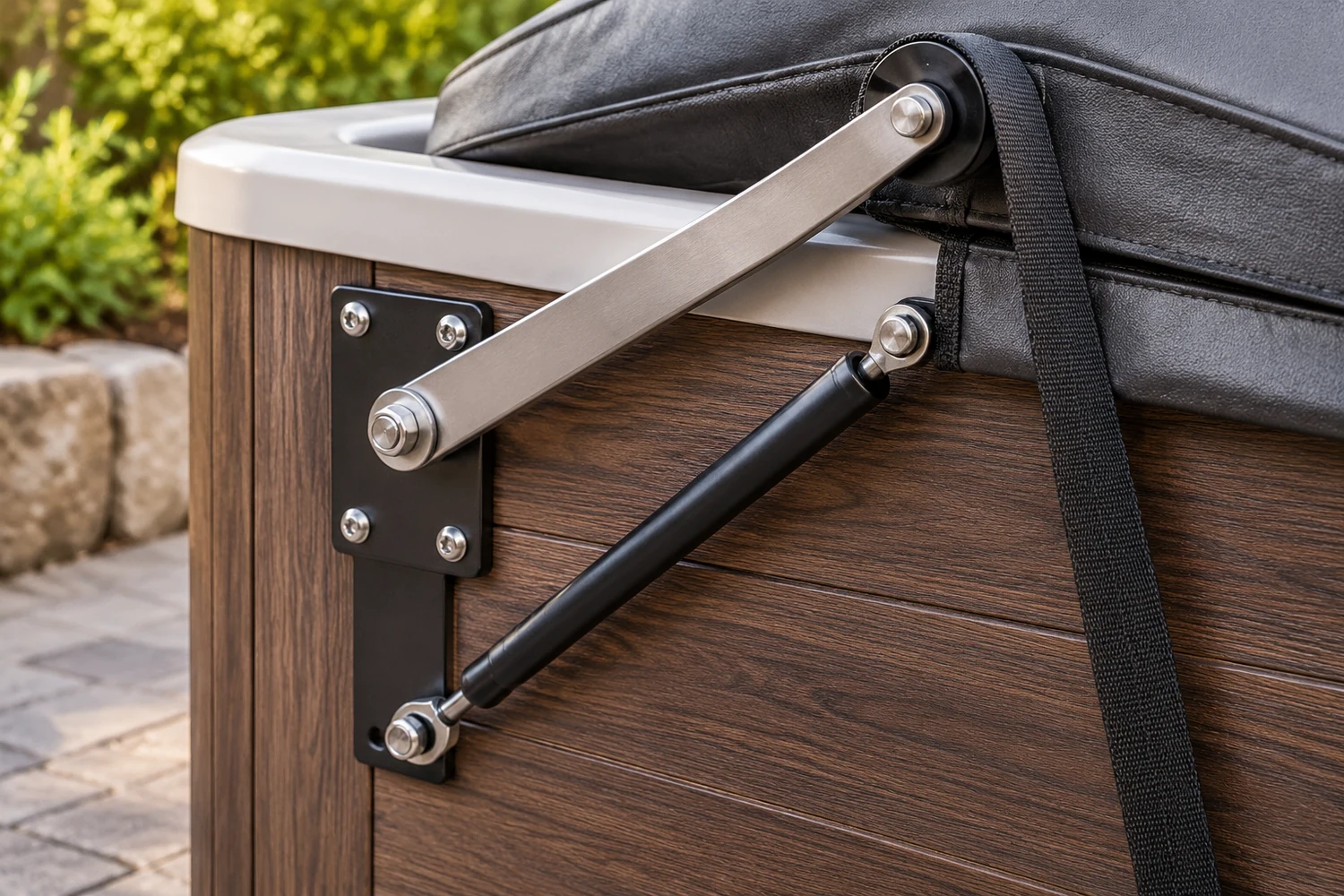
Top, low and under-mount describe where the brackets sit on the cabinet, and the cabinet decides which is available. A top mount needs structure behind the upper rail; a low mount sits on the panel below the rim. An under-mount reaches beneath the cabinet, which only works if the base allows it.
Choosing a model first and then hunting for a mounting point inverts it: mount type is an output of the cabinet survey, not a feature to pick from a list.
What the panel can take
Bracket fixing is either through-bolt or clamp, and the surface the bracket bears on decides which is usable. A thin or unsupported panel may take neither convincingly, however well the lifter is rated. The question is about the cabinet: the same bracket behaves differently on a framed panel and on a skin over foam. Where the panel will take neither a through-bolt nor a clamp, the remaining option is a floor-standing frame: the arms and the cover load sit on its own base, and the cabinet only has to resist the cover.
A straight-on photograph of the panel where the brackets would land answers more than a description; include the rim so the fixing height is visible.
The cover is the load
The lifter is rated by the widest cover it carries when folded, so the cover specification comes first. Cover size, fold arrangement and handling requirements define the load, and the spa covers page sets out how size, corner radius, hinge and fold are quoted together.
In use the number that matters is wet weight – a cover that has taken on water loads the arms differently from its dry figure.
See the cover is the load for how size, corner radius, hinge and fold are quoted together – the four figures that set the weight the arms carry.
Lift assist is a weight decision
Manual, gas strut and hydraulic assistance are the three arrangements quoted, specified where the cover weight calls for it and the cover construction is confirmed first. Assistance changes the mechanism and the envelope it occupies, so it is settled at the same visit as the clearance measurement.
Side clearance belongs at the arms
Side clearance is the space beside the spa for the arms at rest, measured at the height the arms will sit rather than at ground level. A deck edge, a handrail or the route people walk past all reduce that space, and none appear in a footprint drawing.
See surround clearance for how a deck edge, handrail or walkway reduces the space beside the spa.
The arc above the spa
The cover rises before it travels back. Whatever sits above the spa — a shelter roof, a beam, a low soffit — intrudes on that arc, and the intrusion grows as the cover rises. This is the clearance most often missed, because it is measured looking down instead of up.
Photograph the spa from the side with the roofline in frame; a dimension with no reference point cannot be checked against a proposal.
Fit is a combination, not five answers
Mount type, rear clearance, side clearance, cover width and assist constrain each other. A wider cover needs more rear clearance to swing; a heavier cover may need assistance, which occupies space beside the cabinet. That is why compatibility is confirmed as a combination – mount, clearances, cover width and assist together – rather than part by part.
Comparing two proposals
Two quotes are only comparable if both answer the same fields: mount type, the cabinet width range the lifter is rated for, rear clearance, side clearance, the widest cover carried when folded, lift assistance and the bracket fixing method. Where a proposal leaves clearance out, it has not answered the site’s question; ask for it in writing against your measurements.
Frequently asked questions
How much clearance is needed behind a spa for a cover lifter?
Enough for the cover to fold back clear of the wall or fence behind the spa. The figure is confirmed against the specific lifter, because it depends on the cover width and the mechanism rather than on a universal rule.
Does every lifter fit a similarly sized spa?
No. Mount type, cabinet construction and the clearance behind and beside the spa decide whether a lifter can be fitted, so a similar cover size does not make two installations equivalent.
Can a lifter be fitted without drilling the cabinet?
Some models clamp to the cabinet edge. Whether that is acceptable depends on the panel and the spa frame, and it is confirmed per enquiry rather than assumed from the lifter type.
Is the space above the spa part of the clearance?
Yes. The cover rises through an arc before it travels back, so a roof, beam or low soffit above the spa can block an installation that measured correctly at ground level.
Next step
The cover lifters page lists the clearance and mounting fields a proposal should answer. If the cabinet is being finished at the same time, skirt panels sets out the panel questions that affect where a bracket can land, and spa steps belong in the same site survey. Send the site photographs and your measurements through contact and the reply will say what is still open. The wider range sits on the spa components overview.
Have a product or sourcing question?
Tell us about your requirements and the decision you are working on.
Discuss your requirements