
What Size Heat Pump for My Spa or Pool?
Most sizing questions get answered with a number, and the number is the last thing that should be decided. A heat pump is sized by three things a catalogue page cannot tell you: how much heat the water loses, how quickly the owner wants a temperature change, and what the site allows.
Start with heat loss, not water volume
Volume tells you how much water has to move. It does not tell you how fast that water gives its heat away.
Two spas of the same volume behave differently when one sits covered on a sheltered terrace and the other sits open to wind on a roof: the second works against a continuous loss, not a one-off warm-up. So the first question is what the water body loses in the coldest month it is used, not how many litres it holds.
Three answers move the requirement more than a small difference in volume: year-round or seasonal use, indoors or under cover or fully exposed, and whether temperature must hold overnight or only during a session.
Separate holding temperature from raising it
Collapsing this distinction produces units that are either over-specified or disappointing.
Holding a temperature means replacing heat lost hour by hour: a small, continuous load. Raising it means heating the whole body of water inside a chosen window — after a water change, before guests arrive, on the first cold day of the season.
A unit chosen for holding recovers slowly. One chosen for fast recovery costs more, needs more space and often a different supply. The mistake is buying for one job and expecting the other, so write the recovery window into the brief: fill temperature to set temperature within a stated time is the buyer’s decision, and the most useful line in the enquiry.
Compare capacity only at its rating condition
A quoted capacity is measured at a stated condition. The same unit delivers differently at another air temperature, water temperature or humidity level, which is why two units with the same headline figure are not interchangeable. Compare proposals at the condition the project will run in, and ask for that condition beside the figure.
Two site factors quietly undo a good number:
- Airflow. Boxed in by a wall, fence or planting, a unit recirculates its own cold discharge and loses output.
- Cover use. A covered spa loses far less heat, which changes the holding load. If a replacement cover is part of the project, the spa covers page sets out what to measure.
Match the water circuit before the unit
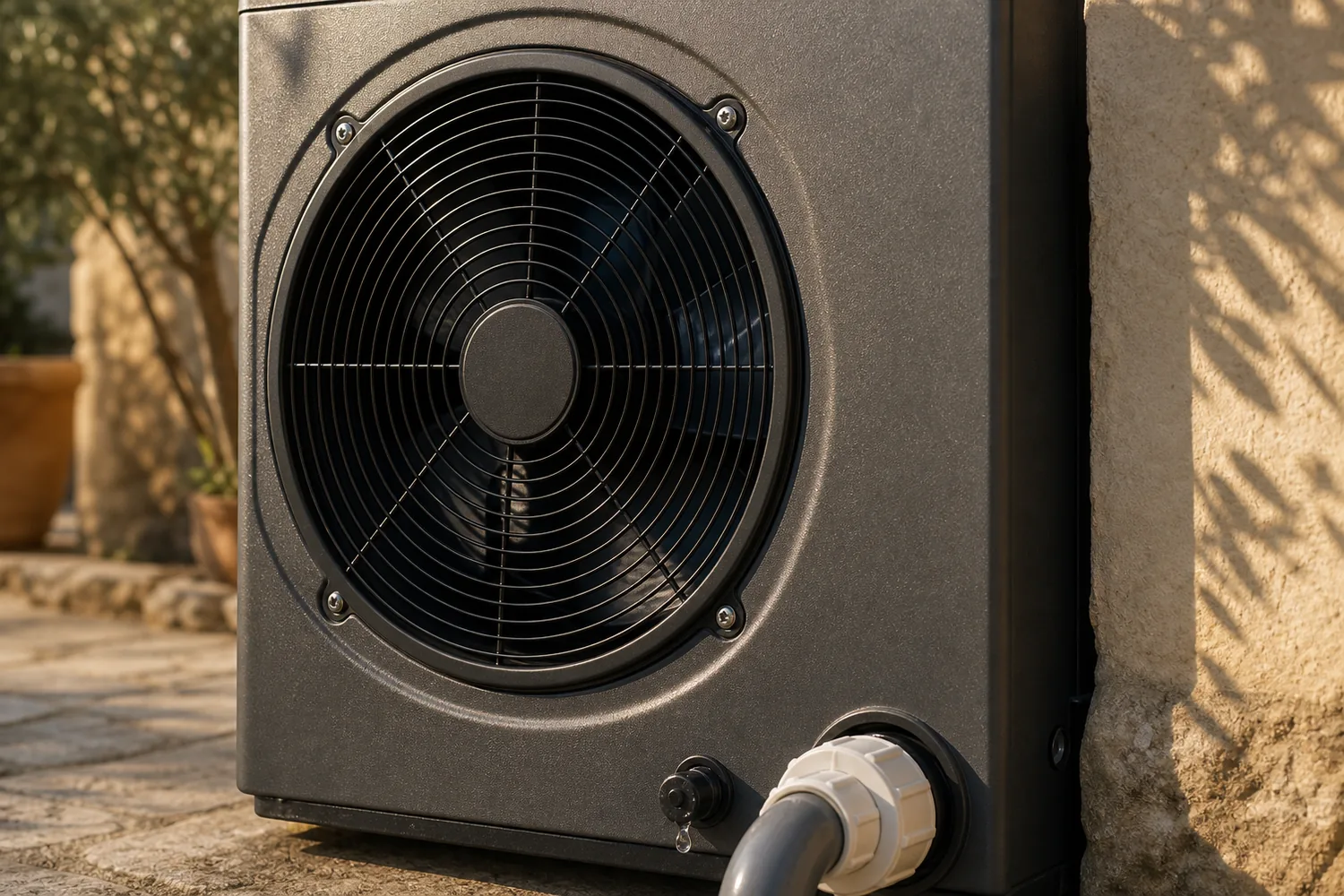
A heat pump has a flow requirement. Below it, the unit will not deliver its rating whatever the label says, and many units will protect themselves and stop.
Connection size must meet the existing plumbing without a restrictive adaptor; bore, wall and end fittings are what a PVC hose enquiry is built around. The circulation pump must push the required flow through the unit and the rest of the circuit — one sized for filtration alone may not carry the extra path, which is why label data and port references start the water pumps page. Bypass, isolation valves and drain points are cheaper on the drawing than afterwards.
Treat the supply as a shortlist filter
Supply is where a technically suitable unit becomes commercially impossible. Single or three phase, the market’s voltage and frequency, the capacity available on site and the distance from the distribution point narrow the field before any model is discussed.
Ask for it in writing, with a photograph of the existing distribution point. Where controls already exist, note what they are: a unit that cannot talk to them is a change of scope, not a swap. Refrigerant follows the model and market, and is confirmed with the quotation rather than chosen from a list.
Write the brief as one page
An enquiry that can be quoted without a second round of questions usually contains:
- Water body: volume, indoor or covered or open air, seasonal or year-round.
- Targets: set temperature wanted, and the recovery window acceptable from a cold start.
- Heat loss context: cover used or not, wind exposure, coldest conditions of use.
- Water circuit: pipe size, pump label data, route length and elevation.
- Supply and installation: available supply, phase, distance from source, position, airflow clearance, where sound matters.
- Market: destination country and the documentation required there.
Capacity, efficiency and sound figures are confirmed per enquiry against the documentation for the proposed model.
Frequently asked questions
Can a heat pump be sized from water volume alone?
No. Volume sets how much water has to be heated; heat loss, cover use, exposure, target temperature and the recovery window decide the capacity needed. Two spas of the same volume can need different units.
Is a bigger heat pump always better?
Not automatically. A larger unit recovers faster but needs more space, more airflow clearance and often a different supply, and it runs shorter cycles in a small water body.
Why do two heat pumps of the same capacity perform differently?
Because capacity is quoted at a rating condition. Air temperature, water temperature and humidity all change what a unit delivers, and a figure without its condition cannot be compared with another.
Do I need to change the existing pump when adding a heat pump?
Often the flow requirement decides it. The heat pump needs a minimum flow through it, so the existing pump and pipe size are checked first. If they cannot carry the additional path, one of them changes.
Next step
Review the application notes on the heat pumps page, then send your volume, targets, recovery window, site conditions and supply details through contact. If a figure is unknown, say so — a stated unknown is easier to resolve than an assumed number. The spa components overview covers the rest of the system.
When the flow side is the question rather than the heat side, how to choose spa jets covers what decides a jet match, and the spa filter cartridge replacement and sizing guide covers the cartridge that sits before the pump.
Have a product or sourcing question?
Tell us about your requirements and the decision you are working on.
Discuss your requirements